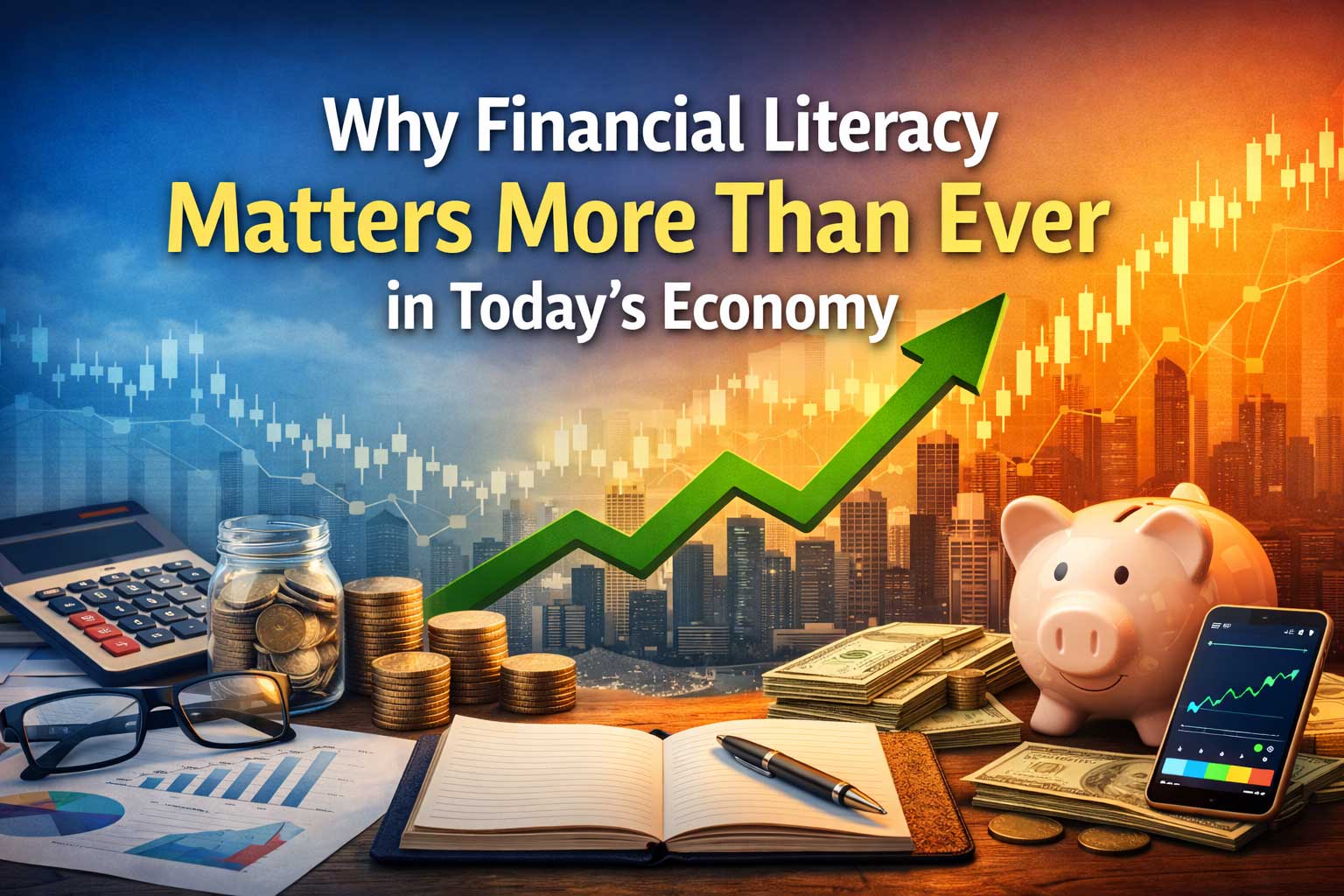
Financial literacy used to feel like a “nice-to-have” life skill—something you picked up over time, or something only “money people” needed. Today, it’s closer to a survival skill. The modern economy rewards people who understand how money moves, how debt works, how to protect themselves from financial risks, and how to make decisions that compound in their favor. At the same time, it punishes confusion and passivity faster than ever.
This isn’t about becoming a stock market expert or learning complicated finance jargon. Financial literacy is about being able to make everyday money decisions with clarity—decisions that protect your present and build your future. It’s about knowing what to do when your bills rise, your income changes, a family emergency hits, or a new financial product shows up on your phone with a “limited-time offer.”
If you’ve ever felt like money is harder than it “should” be—like you can earn and still struggle, save and still feel behind, work hard and still feel uncertain—financial literacy is one of the most powerful tools you can build. Not because it magically makes you richer overnight, but because it changes how you think, plan, and act. And those changes show up in your bank balance, your stress levels, your freedom, and your options.
This complete guide explains why financial literacy matters more than ever right now, what has changed in the economy, what financial literacy actually includes, and how to build it in a realistic way—whether you’re starting from zero or rebuilding after mistakes.
What Financial Literacy Really Means (And What It Doesn’t)
Financial literacy is the ability to understand and use money skills effectively. That includes how you earn, spend, save, borrow, protect, and grow money—based on your goals and your life.
Financial literacy includes:
- Understanding cash flow: Money in vs. money out, and how to control the gap.
- Budgeting with purpose: Creating a plan that reflects your real life (not a fantasy).
- Saving and emergency planning: Preparing for the expected and unexpected.
- Using credit wisely: Understanding interest, credit scores, and debt strategies.
- Investing basics: Knowing how to grow money over time with risk awareness.
- Protecting your finances: Insurance, fraud prevention, and smart decision-making.
- Making tradeoffs confidently: Choosing what to prioritize without guilt or confusion.
Financial literacy does not require:
- Being “good at math” beyond basic arithmetic
- Predicting markets or picking “winning” stocks
- Becoming obsessed with money or living extremely
- Having high income (financial literacy matters at every income level)
- Knowing every rule in the tax code
Financial literacy is practical. It’s the skill of making fewer expensive mistakes—and more consistent, beneficial choices.
Why Financial Literacy Matters More Today Than It Did for Previous Generations
It’s not your imagination: money feels more complicated now. That’s not because you’re failing—it’s because the economy is structured differently than it was decades ago. The decisions you make today often have higher stakes, faster consequences, and fewer safety nets.
1) The cost of living can change faster than incomes
In many places, essential expenses like housing, food, utilities, transportation, healthcare, and education can rise quickly. Even if your income grows, it may not grow at the same pace. This creates a common modern problem: earning more but feeling like you’re still treading water.
Financial literacy helps you:
- Identify which expenses matter most
- Reduce “silent leaks” that drain cash flow
- Build systems to handle rising costs without panic
- Make proactive changes before a situation becomes a crisis
When prices are unstable or rising, financial skills matter more because your margin for error shrinks.
2) Financial products are easier to access—but harder to evaluate
In the past, major financial decisions often required face-to-face meetings and paperwork. Today, you can open credit lines, buy investments, take loans, and subscribe to payment plans in minutes from your phone.
Convenience is powerful—but it comes with risk:
- Easy credit can lead to fast debt
- “Pay later” plans can hide true costs
- Investing apps can make speculation feel like saving
- Subscription models can turn small payments into permanent drains
- Marketing can make risky products feel normal
Financial literacy is your filter. It helps you ask:
- What does this cost over time?
- What happens if I miss a payment?
- Is this helping me or trapping me?
- What is the worst-case scenario?
- Am I buying a product—or buying a feeling?
3) The economy demands more self-management
Modern life often includes:
- Gig work or inconsistent income
- Multiple income streams
- Freelancing without employer benefits
- More responsibility for retirement planning
- More responsibility for healthcare decisions
- More responsibility for insurance coverage
This shift means individuals must manage more “financial infrastructure” themselves. If you don’t understand the basics, you may unintentionally pay more, lose benefits, miss opportunities, or carry unnecessary risk.
4) Debt is more common and more normalized
Debt has always existed, but today it can appear in more forms:
- Credit cards
- Student education-related debt
- Auto financing
- Personal loans
- App-based installment payments
- Overdraft and fee-based borrowing
- Cash advance products disguised as “help”
The danger isn’t just debt—it’s unmanaged debt: debt with high interest, unclear terms, or no plan. Financial literacy helps you understand:
- Interest rates and how they compound against you
- Minimum payments and how they stretch debt for years
- The difference between “good” and “bad” borrowing
- How to escape debt strategically without shame
5) Scams, fraud, and manipulation are more sophisticated
The modern economy includes an entire ecosystem designed to capture your attention and money. Some of it is legal but exploitative; some of it is outright fraud.
Common modern traps include:
- Fake investment promises
- Overpriced “courses” selling unrealistic income claims
- Identity theft
- Subscription tricks and free-trial traps
- Social engineering (messages that create urgency and fear)
- Predatory lending disguised as “solutions”
Financial literacy helps you slow down, verify, and protect yourself.
6) Your financial decisions affect your mental health more than ever
Money stress is not just “in your head.” It can impact sleep, relationships, confidence, and long-term wellbeing. When money feels uncertain, life feels uncertain.
Financial literacy builds:
- Confidence in your decisions
- A sense of control
- Better communication with partners and family
- Reduced anxiety through planning and preparation
It turns money from a constant emergency into a manageable system.
The Hidden Cost of Low Financial Literacy
Many people assume the biggest money problem is not earning enough. Sometimes it is. But very often, the deeper issue is not knowing how to manage what you have in a way that protects you.
Low financial literacy can quietly cost you through:
- Paying unnecessary interest
- Paying avoidable fees
- Missing employer benefits
- Buying insurance that doesn’t fit your needs (or having none at all)
- Overpaying for convenience
- Falling into lifestyle inflation
- Choosing high-risk shortcuts that backfire
- Losing money to scams
- Delaying investing because it feels intimidating
The tragedy is that these costs often don’t feel like “choices.” They feel like life happening. Financial literacy helps you recognize the patterns so you can change them.
What Financial Literacy Looks Like in Real Life
Financial literacy is not a certificate. It’s behavior.
A financially literate person doesn’t have a perfect life. They still face emergencies, mistakes, unexpected job changes, and rising costs. The difference is that they have tools.
Here are examples of financial literacy in action:
Example: Bills rise unexpectedly
- Low literacy response: Panic, use credit, hope it gets better.
- High literacy response: Review cash flow, cut low-value expenses, negotiate where possible, adjust budget categories, and protect essentials.
Example: Offered a new credit product
- Low literacy response: “Sure, why not?” (focus on short-term relief)
- High literacy response: Compare interest, fees, terms, risk, and alternatives before deciding.
Example: Bonus income arrives
- Low literacy response: Spend most of it, then feel disappointed later.
- High literacy response: Allocate it intentionally: emergency fund, debt payoff, future savings, and some guilt-free spending.
Example: Want to invest but feel intimidated
- Low literacy response: Avoid investing or gamble on hype.
- High literacy response: Learn basics, choose a simple long-term plan, and invest consistently.
Financial literacy is a set of habits that create stability and momentum.
Why Financial Literacy Is a Wealth-Building Multiplier
Even small improvements in financial literacy can have large results because money compounds over time—both positively and negatively.
Compounding works in two directions:
- Positive compounding: saving, investing, improving income, reducing fees and interest
- Negative compounding: high-interest debt, repeated fees, missed payments, poor insurance coverage, costly mistakes
Financial literacy helps you tilt compounding in your favor. It turns your financial life from reactive to strategic.
The Core Areas of Financial Literacy You Need in Today’s Economy
Financial literacy isn’t one topic. It’s a toolkit. The most important areas can be grouped into five categories:
- Cash Flow Management
- Saving and Emergency Readiness
- Debt and Credit Mastery
- Investing and Wealth Building Basics
- Protection and Long-Term Planning
Let’s break them down in depth.
1) Cash Flow Management: The Foundation of Everything
Cash flow is the relationship between what comes in (income) and what goes out (spending). You can have a decent income and still struggle if your spending system is chaotic. You can also have a modest income and build stability if your cash flow is intentional.
Step 1: Know your “real numbers”
Many people think they know their monthly expenses, but they underestimate because they forget:
- annual payments (insurance, school fees, memberships)
- irregular spending (repairs, gifts, travel, medical)
- “small daily” expenses that add up
A financially literate approach is to calculate:
- your average monthly essentials
- your average monthly flexible spending
- your true monthly obligations (including irregular costs spread monthly)
Step 2: Create categories that reflect reality
The best budget is the one you actually use. A realistic budget includes:
- essentials (housing, utilities, food, transport)
- debt payments (minimums + payoff plan)
- savings (emergency + goals)
- flexible spending (fun, dining, personal)
- irregular costs (future expenses you can predict)
Step 3: Build a simple system
Financial literacy isn’t about having the most complex spreadsheet. It’s about having a system you can maintain. Examples:
- allocate money on payday into categories
- set automatic payments for essentials
- set automatic transfers to savings
- review weekly for 10 minutes
- review monthly for 30 minutes
Step 4: Understand the “gap”
The gap is what’s left after essentials and minimum obligations. That gap determines your options:
- bigger gap → more saving/investing power
- smaller gap → more need for optimization and income growth
Financial literacy helps you protect and expand that gap.
2) Saving and Emergency Readiness: Stability in an Unstable World
In a fast-changing economy, an emergency fund is not just responsible—it’s protective.
Why emergency savings matter more now
Modern life brings more volatility:
- job changes and layoffs
- sudden medical costs
- family obligations
- cost spikes (rent increases, repairs)
- income fluctuations
Emergency savings do something powerful: it buys time and choices.
What an emergency fund really does
It prevents you from needing to:
- use high-interest debt
- miss bills and damage your credit
- sell investments at a bad time
- accept the first option out of desperation
- borrow from family and create stress
The psychology of savings
Many people avoid saving because it feels slow. Financial literacy reframes saving as:
- risk management
- freedom insurance
- future stability
Saving is not just money in an account. It’s reduced stress and increased power.
How to save when it feels impossible
Financial literacy focuses on process over perfection:
- start small and automated
- save “first” even if it’s a tiny amount
- build consistency before chasing big numbers
- use windfalls strategically
- reduce friction by separating the money
Even small savings can stop a small emergency from becoming a financial disaster.
3) Debt and Credit Mastery: Avoiding the Interest Trap
Debt is not always evil. But debt without understanding is dangerous.
Why debt is more dangerous today
Debt is easier to get, and payments can be spread across many products. That creates “payment fog,” where you don’t fully feel the total cost.
Key concepts every person should know
- Interest: the cost of borrowing
- APR: the yearly cost, including some fees
- Minimum payment: the amount that keeps you “current” but can keep you in debt longer
- Credit utilization: how much of your available credit you’re using
- Credit score factors: payment history, utilization, age of credit, credit mix, new inquiries
The difference between helpful borrowing and harmful borrowing
More helpful borrowing tends to have:
- clear purpose (asset or long-term value)
- manageable payments
- reasonable interest
- a plan to pay off
More harmful borrowing tends to have:
- high interest
- unclear terms
- payments that crowd out essentials and savings
- borrowing for lifestyle, impulse, or emergencies
- repeated refinancing without solving the root problem
Financial literacy helps you escape debt with strategy
A practical debt plan includes:
- listing debts clearly (balance, rate, minimum, due date)
- choosing a payoff method you can stick to
- avoiding new debt while paying down old debt
- building a small emergency buffer to prevent backsliding
Even if you don’t pay off debt immediately, a plan gives you momentum and control.
4) Investing and Wealth Building Basics: Keeping Up With Time
Investing matters because saving alone often struggles to keep pace with long time horizons. Money that sits still can lose purchasing power over time. Investing is how people build long-term wealth, fund retirement, and create future flexibility.
Why investing feels harder now
Investing is more accessible, but also more distracting:
- constant news cycles
- social media hype
- fear of missing out
- confusing financial language
- pressure to “get rich fast”
Financial literacy cuts through the noise with simple principles:
- invest for long-term goals
- diversify rather than bet everything on one idea
- understand risk and time horizon
- focus on consistency more than perfection
The most important investing idea: time matters
The longer your money has to grow, the less you need extreme strategies. Financial literacy encourages:
- starting as early as you can (even with small amounts)
- investing regularly
- staying calm during volatility
- avoiding emotional decisions
Wealth building is more than investing
Financial literacy also includes:
- career growth and skill development
- building multiple income streams (carefully and realistically)
- protecting your earning power
- avoiding financial disasters
- making intentional lifestyle choices that support your goals
Wealth is not just money. Wealth is options.
5) Protection and Long-Term Planning: The Part People Forget
Financial literacy includes protecting what you build.
Insurance literacy
Insurance is not exciting, but it matters. You don’t buy insurance hoping to “win.” You buy it to prevent your life from being financially destroyed by a major event.
Insurance decisions can include:
- health coverage choices
- life insurance for dependents
- disability protection
- property and vehicle coverage
- liability awareness
Financial literacy means understanding:
- what risks you actually face
- what coverage you need
- what you can afford
- how to avoid being underinsured or paying for coverage that doesn’t match your life
Planning for aging and retirement
Many people avoid retirement planning because it feels far away. But retirement isn’t just an age—it’s a math problem:
- how long you may need income
- how much you’ll spend
- what sources of income you’ll have
- how inflation might impact costs
Financial literacy helps you start with basics:
- define a future target
- build a consistent saving/investing habit
- increase contributions as income grows
- avoid borrowing from the future for temporary comfort today
Estate and family planning basics
Even simple planning matters:
- keeping documents organized
- ensuring beneficiaries are updated
- communicating key information with trusted family members
- reducing chaos during emergencies
You don’t need to be wealthy to plan. You just need to be intentional.
Why Financial Literacy Is Also a Social Skill
Money decisions are rarely isolated. They impact relationships, families, and communities.
Financial literacy improves communication
Many conflicts happen not because people are “bad,” but because they:
- avoid money conversations
- don’t know how to plan together
- don’t understand each other’s financial fears or habits
Financial literacy gives you language and structure:
- shared goals
- spending boundaries
- clear responsibilities
- regular check-ins
Financial literacy reduces shame
Many people carry quiet shame about money mistakes. Shame keeps you stuck because it encourages avoidance. Financial literacy replaces shame with skills:
- “I didn’t know” becomes “I’m learning”
- mistakes become feedback
- improvement becomes a system
The New Economy: Why “Common Sense” Isn’t Enough Anymore
People often say money should be “common sense.” But common sense doesn’t work well in an economy designed to be complex and persuasive.
Today, businesses compete for your spending with:
- targeted ads
- psychological pricing
- one-click purchases
- subscription models
- “limited-time” urgency tactics
- social proof and influencer marketing
Financial literacy is how you regain control. It helps you pause and ask:
- Is this aligned with my goals?
- Is this solving a real problem—or creating a new one?
- What does this cost me long-term?
- What am I sacrificing by choosing this?
In the modern economy, your attention and decisions are valuable. Financial literacy helps you protect both.
A Practical Framework to Build Financial Literacy (Without Overwhelm)
You don’t build financial literacy by reading one article and becoming perfect. You build it by learning, applying, and repeating.
Step 1: Build clarity (one hour)
- Write down your monthly income sources
- List your fixed essentials
- List your debts and minimum payments
- Estimate your flexible spending
- Identify your current savings
The goal is not perfection. The goal is visibility.
Step 2: Choose one focus for the next 30 days
Pick the highest-impact area:
- If you’re behind on bills → focus on cash flow stability
- If you have high-interest debt → focus on debt strategy
- If you have no savings → focus on emergency fund
- If you’re stable but not growing → focus on investing basics
Trying to fix everything at once often leads to quitting.
Step 3: Create a simple system you can repeat
- One weekly money check (10 minutes)
- One monthly money reset (30 minutes)
- One automatic savings transfer
- One plan for spending categories
Step 4: Build “financial reflexes”
Financial reflexes are habits that protect you automatically:
- wait 24 hours before big purchases
- check account balances before spending
- track subscriptions monthly
- always know your next bill due date
- keep a small buffer so you don’t live at zero
Step 5: Increase the difficulty slowly
Once you’re stable:
- increase savings rate gradually
- begin investing consistently
- learn about insurance coverage
- plan for future goals
- improve income through skills and negotiation
Financial literacy is like fitness: consistency beats intensity.
Realistic Scenarios: How Financial Literacy Changes Outcomes
Scenario 1: The “everything is fine” budget
A person earns enough to cover bills, but every month they end up using credit for “small extras.” They tell themselves it’s temporary, but the pattern repeats.
Financial literacy solution:
- Identify the true monthly average for flexible spending
- Create a category for “irregular costs”
- Automate a small savings buffer
- Set a weekly spending limit with a clear number
- Use a plan to stop surprises from becoming debt
This doesn’t require earning more first. It requires a system.
Scenario 2: The “income increased but life got harder” problem
A person receives a raise, but after a few months, their lifestyle expands and they still feel stressed.
Financial literacy solution:
- Split the raise intentionally: part to goals, part to lifestyle
- Increase savings and debt payoff automatically
- Avoid expanding fixed expenses too fast
- Keep flexibility and margin as priorities
Financial literacy helps you keep progress instead of upgrading it away.
Scenario 3: The “investment confusion” trap
A person wants to invest but feels overwhelmed. They either avoid it or follow hype without understanding risk.
Financial literacy solution:
- Start with basics: goals, time horizon, risk tolerance
- Choose a simple consistent investing approach
- Avoid emotional decisions based on news
- Focus on long-term behavior, not short-term performance
The biggest investing mistake is not starting because you want to start perfectly.
The Long-Term Benefits of Financial Literacy
Financial literacy pays off in ways that go beyond money.
1) More options
Options are what people really want:
- the option to change jobs
- the option to move
- the option to handle emergencies calmly
- the option to help family without ruining your future
- the option to take breaks or pursue better opportunities
2) Less stress
You can’t control the entire economy, but you can control your preparation and choices. That alone reduces anxiety.
3) Better decision-making
Financial literacy improves how you think:
- long-term mindset
- clearer priorities
- fewer impulsive choices
- stronger boundaries
4) Better outcomes for future generations
Financial literacy is transferable. When you learn it, you can teach it—directly or indirectly—to children, siblings, and others around you. That can change family trajectories.
Common Myths That Keep People Stuck
Myth 1: “I don’t earn enough to worry about this.”
Financial literacy matters most when money is tight because mistakes are more expensive. Even small improvements can create breathing room.
Myth 2: “I’m bad with money.”
Money skills are learned. If you weren’t taught, that’s not a character flaw. It’s a training gap.
Myth 3: “Budgeting means no fun.”
Budgeting isn’t punishment. It’s permission. It tells you what you can spend without regret.
Myth 4: “Investing is only for rich people.”
Investing is a tool for long-term growth. Starting small can still matter because consistency and time are powerful.
Myth 5: “I’ll learn later.”
Later is rarely easier. The longer you wait, the more time you lose—and the more likely small problems become bigger ones.
A 30-Day Plan to Improve Financial Literacy (Simple and Practical)
If you want real progress quickly, use this plan.
Week 1: Visibility and tracking
- Write down income, fixed bills, debts, savings
- Track every expense for 7 days (no judgment)
- Identify your top 3 spending categories
Week 2: Build a basic spending plan
- Create 5–7 categories that match your real life
- Set a weekly limit for flexible spending
- Cancel or pause one low-value subscription or recurring expense
Week 3: Emergency buffer and debt clarity
- Start an automatic transfer to savings (even small)
- List debts with rates and minimums
- Choose a payoff strategy and set a target
Week 4: Future focus
- Define one 12-month goal (savings, debt, skill, or investing)
- Create one habit that supports it (weekly review, automatic savings, meal planning, etc.)
- Set a monthly money meeting with yourself (or with your partner)
After 30 days, you don’t need perfection—you need momentum.
Frequently Asked Questions
How do I know if I’m financially literate?
If you can explain your monthly cash flow, have a plan for bills, understand your debts, and make money decisions with intention instead of panic, you’re building strong financial literacy. It’s a spectrum, not a label.
What’s the fastest way to improve financial literacy?
Focus on one high-impact area: cash flow, emergency savings, or debt. Then build a simple routine: weekly check-in, monthly review, and automation.
Can financial literacy help even if the economy is difficult?
Yes—especially then. You may not control prices or job markets, but you can control your preparation, spending plan, and risk management.
Is budgeting the most important part?
Budgeting is the foundation because it controls cash flow. But financial literacy also includes saving, debt, protection, and investing. Budgeting is where most people start because it creates immediate clarity.
What if I’ve made major money mistakes?
Mistakes are common. Financial literacy helps you recover by turning lessons into systems. The most damaging mistake is repeating the same pattern without learning why it happened.
Conclusion: Financial Literacy Is Your Advantage in a Changing Economy
In today’s economy, financial literacy is no longer optional. It’s the difference between reacting and choosing. It’s how you protect yourself from rising costs, confusing financial products, and avoidable debt. It’s how you reduce stress, build stability, and create future options—even if you’re starting small.
Financial literacy doesn’t require perfection. It requires honesty, simple systems, and consistent habits. When you understand your money, you stop feeling like life is happening to you—and start building a life you can steer.
The economy will keep changing. New products will appear. Costs will shift. Opportunities will come and go. But the one thing that will always pay you back is your ability to make smart, confident decisions with the money you have. That’s what financial literacy gives you—and why it matters more than ever.