
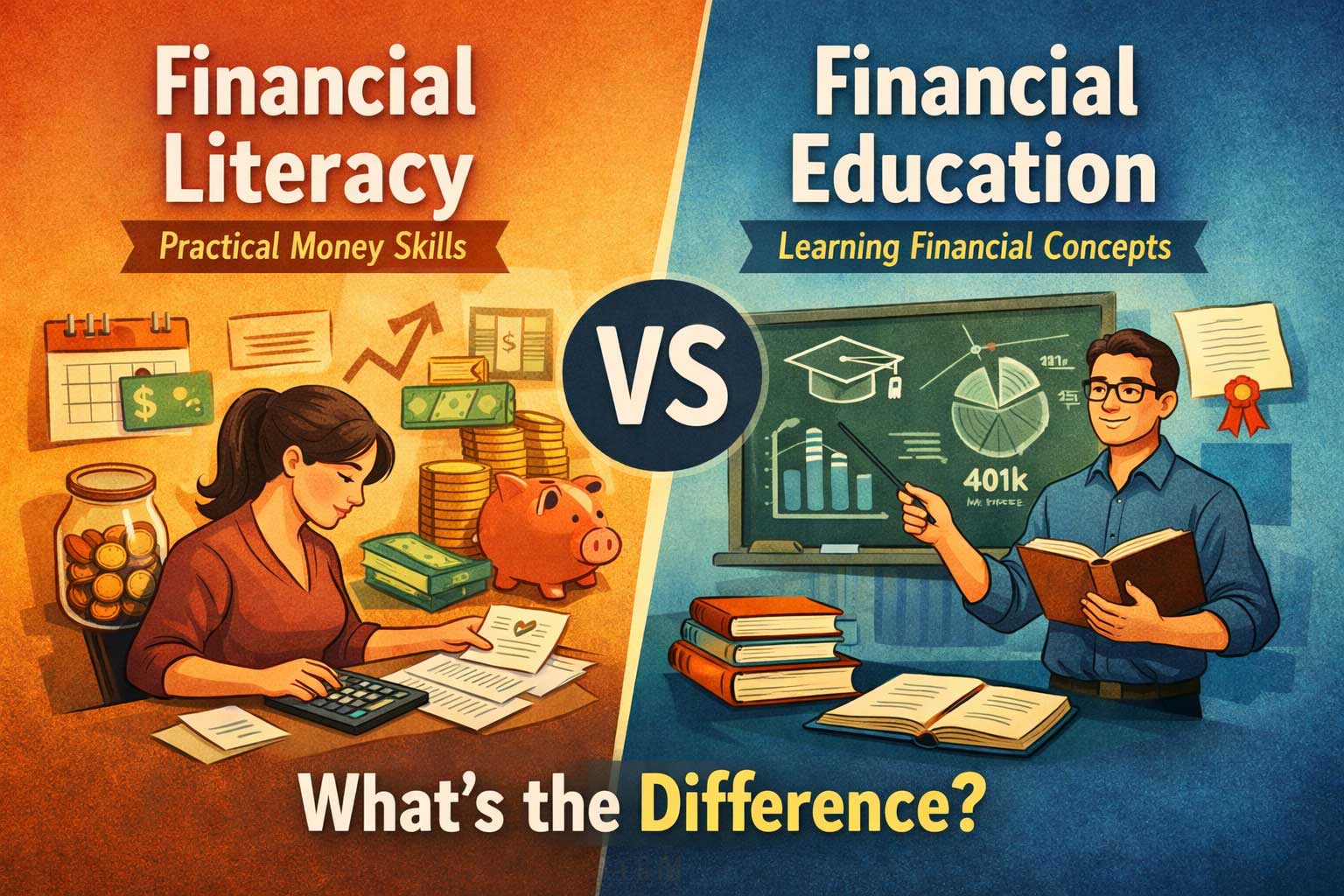
People often say, “We need more financial education,” when they really mean, “People need to be more financially literate.” Other times, they praise someone as “financially educated” because that person can explain investing terms—but that same person might still overspend, miss payments, or panic-sell during market volatility. The confusion is understandable because the two ideas overlap. But they are not identical.
Understanding the difference matters because it changes how you improve your money life. If you treat money problems as purely a knowledge issue, you might buy course after course and still struggle. If you treat them as purely a behavior issue, you might try willpower tactics without understanding the basics—leading to costly mistakes. The best outcomes come from building both: the education that provides concepts and tools, and the literacy that turns those concepts into consistent, real-world decisions.
This article breaks down what each term means, how they differ, how they work together, and how you can strengthen both—whether you’re an individual trying to get ahead, a parent teaching kids, an educator designing curriculum, or an employer supporting employees.
Quick Definitions: The Simplest Way to Understand It
What is Financial Education?
Financial education is the process of learning about money. It includes the lessons, courses, workshops, articles, coaching, and training that teach financial concepts and skills.
Think of it as: the input (teaching and learning).
Examples of financial education:
- A budgeting workshop at work
- A high school personal finance course
- A book on investing basics
- A coaching session on debt payoff strategies
- A class explaining credit scores and interest rates
What is Financial Literacy?
Financial literacy is the ability to understand and use financial knowledge to make effective decisions in real life. It includes comprehension, judgment, habits, and application.
Think of it as: the output (real-world capability and results).
Examples of financial literacy:
- Comparing loan offers and understanding the true cost
- Paying bills on time consistently
- Building an emergency fund and actually keeping it intact
- Avoiding scams because you recognize red flags
- Understanding risk and staying calm through normal market ups and downs
Key takeaway:
- Financial education = learning about money
- Financial literacy = using what you learned to manage money well
The Core Difference: Knowledge vs Application
A useful way to separate the two:
- Financial education focuses on exposure to information: terminology, rules, frameworks, and tools.
- Financial literacy focuses on competence: can you apply that information accurately under real-life pressure, temptation, and uncertainty?
You can receive financial education and still not be financially literate—just like someone can take a driving class and still be a dangerous driver if they don’t apply the rules, practice, and stay calm behind the wheel.
A Simple Comparison Table
| Category | Financial Education | Financial Literacy |
|---|---|---|
| What it is | Learning process | Practical capability |
| Focus | Concepts and instruction | Decisions and behaviors |
| Measured by | Completion, participation, quizzes | Outcomes and real-life choices |
| Examples | Classes, books, coaching | Budgeting consistently, avoiding high-interest debt |
| Main question | “What do you know?” | “What do you do—and how well does it work?” |
| Timeframe | Often short-term events | Long-term skill and habit development |
Why People Confuse Them (And Why That’s Risky)
1) They overlap in everyday conversation
Most people use “education” and “literacy” as synonyms. In money topics, that creates sloppy thinking. Sloppy thinking leads to sloppy solutions.
2) Education is easier to deliver than literacy
It’s simpler to offer a course than to ensure people change behavior. So organizations sometimes celebrate “education delivered” even if outcomes don’t improve.
3) Literacy is harder to measure
A quiz can test definitions. Real-life literacy requires tracking behaviors (saving rates, debt levels, emergency preparedness, insurance coverage, decision quality). That’s more complicated—and more personal.
4) Money decisions are emotional
People assume that once you know better, you’ll do better. But money decisions often happen under stress, social pressure, fatigue, or anxiety. Knowledge helps, but it’s not the full solution.
Risk of confusion: You may keep “studying money” without improving your financial reality—or you may blame yourself for lacking willpower when the real issue is a missing foundation of knowledge.
A Real-World Example: Two People, Same Education, Different Literacy
Imagine two coworkers attend the same financial education seminar about budgeting, debt, and investing.
Person A leaves motivated, creates a realistic budget, automates savings, pays off credit cards, and starts investing steadily.
Person B leaves inspired for a week, then reverts to old habits. They still understand the concepts, but they don’t implement them consistently. They keep high-interest debt and never build an emergency fund.
Both received the same education. Only one improved literacy—because literacy includes behavior design, habit formation, emotional management, and follow-through.
The Hidden Ingredients of Financial Literacy That Education Alone Doesn’t Guarantee
Financial literacy is not just “knowing.” It often includes:
1) Decision-making under uncertainty
Real money choices rarely come with perfect information. Literacy means making reasonable decisions even when you’re unsure, like:
- Choosing a mortgage you can afford even if rates fluctuate
- Investing consistently despite scary headlines
- Buying insurance you hope you never use
2) Numeracy and realistic math
Many money mistakes come from misunderstandings about:
- Interest compounding (both saving and debt)
- Inflation’s impact over time
- The difference between a monthly payment and total cost
- The true cost of “buy now, pay later” habits
3) Emotional regulation
A financially literate person can pause before:
- Emotional spending after a stressful day
- Panic selling investments during a downturn
- Taking on debt to impress others
- Avoiding bills because they feel overwhelmed
4) Systems and habits
Literacy shows up as routines:
- Automatic transfers to savings
- Scheduled bill payments
- Regular spending check-ins
- A plan for irregular expenses
- Boundaries with lifestyle creep
5) Context awareness
What works for one person may not work for another due to:
- Income stability
- Family responsibilities
- Health costs
- Local living costs
- Risk tolerance
- Cultural expectations around money
Financial education can teach general rules. Financial literacy adapts those rules to your reality.
Financial Education: What It Usually Covers (And What It Sometimes Misses)
Common topics in financial education
- Budgeting methods
- Saving strategies
- Emergency funds
- Debt payoff techniques
- Credit scores and credit reports
- Banking products
- Investing basics (stocks, bonds, funds)
- Retirement accounts and long-term planning
- Insurance basics
- Taxes (basic concepts)
- Scams and fraud awareness
What financial education sometimes misses
Even good education can fall short if it doesn’t address:
- Behavior change strategies
- Psychological triggers and impulse control
- Shame and avoidance patterns
- Building routines for inconsistent income
- Negotiation skills (salary, bills, interest rates)
- How to choose financial products in the real marketplace
- How to create a personal plan that fits your values
Education often explains “what” and “why.” Literacy demands “how”—and repeated practice.
Financial Literacy: What It Looks Like in Daily Life
Here are practical signs of financial literacy across key life areas:
Cash flow and spending
- You know your essential monthly expenses and can plan around them
- You can distinguish needs, wants, and trade-offs without guilt spirals
- You notice spending patterns early and adjust
- You have a plan for irregular expenses (repairs, gifts, travel, medical)
Saving and resilience
- You keep an emergency fund (even if it’s small)
- You can handle a surprise expense without instant debt
- You can reduce expenses quickly when income drops
- You avoid “all-or-nothing” saving; you aim for consistency
Credit and debt
- You understand interest rates and total repayment cost
- You avoid high-cost debt unless truly necessary
- You pay on time and keep utilization manageable
- You use debt strategically (if at all) instead of emotionally
Investing and long-term planning
- You understand risk versus volatility
- You invest with a plan, not headlines
- You diversify rather than chasing quick wins
- You choose time horizons that match your goals
- You keep fees and taxes in mind (without obsessing)
Protection and risk management
- You insure what would financially ruin you (health, disability, major liabilities)
- You aren’t overinsured in ways that drain your budget
- You keep basic documents organized
- You plan for emergencies beyond money (access, passwords, contacts)
The Relationship: Education Builds Knowledge, Literacy Builds Capability
Financial education is often a starting point. Financial literacy is the destination.
A useful mental model is:
- Education gives you information
- Understanding turns information into insight
- Practice turns insight into skill
- Systems turn skill into consistency
- Consistency creates financial outcomes
If you stop at step 1, you remain educated but not necessarily literate.
Why Financial Literacy Matters More Than Ever
Modern money life is complicated:
- More financial products than ever (and more confusing terms)
- Easier access to credit and installment plans
- Constant marketing pressure through social media
- Faster spending through digital wallets and one-click purchases
- More do-it-yourself investing and financial decisions
- More scams targeting everyday people
In this environment, education alone isn’t enough. You need the literacy to filter, decide, and act.
Common Myths That Keep People Stuck
Myth 1: “If I earn more, my money problems will disappear.”
Higher income can help, but without literacy, spending often rises too. Many people with good incomes still live paycheck to paycheck because habits and systems never changed.
Myth 2: “I’m just bad at math.”
You don’t need advanced math to be financially literate. You need practical understanding:
- Percentages
- Simple interest intuition
- Budgeting categories
- Long-term thinking
Myth 3: “Budgeting means suffering.”
A good budget isn’t punishment. It’s a plan for your money to support your priorities—without anxiety.
Myth 4: “Investing is only for experts.”
Investing basics are learnable. Literacy is less about predicting markets and more about having a long-term plan and sticking to it.
Myth 5: “I’ll start when my life calms down.”
Life rarely calms down on its own. Literacy grows when you build systems that work even during chaos.
How to Build Financial Education the Right Way
If financial education is the learning process, the goal is to learn efficiently and accurately, without getting overwhelmed or misled.
Step 1: Start with foundations
Before advanced investing or complex strategies, master:
- Cash flow basics
- Emergency savings
- High-interest debt management
- Credit fundamentals
- Basic insurance concepts
Step 2: Learn in the order you’ll use it
A practical learning sequence:
- Spending awareness and budgeting
- Emergency fund
- Debt payoff plan
- Credit improvement
- Basic investing
- Retirement planning
- Insurance and protection
- Taxes and long-term optimization
- Estate basics and planning documents
Step 3: Choose learning sources carefully
Good education is:
- Clear and actionable
- Not based on hype or fear
- Transparent about trade-offs
- Focused on fundamentals
- Consistent over time (not trend-chasing)
Step 4: Take notes that turn into action
Instead of collecting information, capture:
- One key idea
- One action step
- One metric to track
- One obstacle and how you’ll handle it
Education becomes useful when it creates behavior.
How to Build Financial Literacy the Right Way
Literacy is built through repetition, systems, and real-world decision practice.
1) Build a simple money system
You don’t need complexity. You need clarity.
A strong basic system includes:
- A primary spending account
- A bill-paying method (automatic or scheduled)
- A savings account for emergencies
- A savings account for planned expenses
- An investing method (automated if possible)
2) Automate what you can
Automation reduces decision fatigue:
- Auto-pay bills to avoid late fees
- Auto-transfer savings after payday
- Auto-invest a fixed amount regularly
Literacy improves when your system supports you.
3) Practice “pause skills” for spending
Before a non-essential purchase, ask:
- Is this aligned with my priorities?
- What am I feeling right now?
- What problem do I think this purchase solves?
- Would I still want this in 48 hours?
This is literacy in action: using awareness to prevent regret.
4) Create rules for common decisions
Rules prevent emotional decisions. Examples:
- “If I can’t buy it twice, I won’t buy it once.”
- “I wait 24 hours for purchases above a certain amount.”
- “I don’t finance wants.”
- “I invest monthly no matter what headlines say.”
5) Use small feedback loops
Once per week:
- Check balances
- Review spending categories
- Confirm bills are paid
- Adjust next week’s plan
Once per month:
- Review goals
- Track net worth (even roughly)
- Evaluate progress and obstacles
Literacy grows through consistent feedback—not occasional motivation.
Where Each Matters Most: Different Life Stages
Teens and young adults
- Education: basic banking, budgeting, credit, scams
- Literacy: resisting peer pressure spending, starting savings habits
Early career
- Education: benefits, retirement options, taxes basics, debt payoff
- Literacy: living below means, building emergency fund, consistent investing
Families and midlife
- Education: insurance, home buying, childcare costs, college planning
- Literacy: balancing competing priorities, planning irregular expenses
Later life
- Education: retirement withdrawals, healthcare costs, estate basics
- Literacy: sustainable spending, avoiding scams, managing risk
Different stages require different education topics—but literacy remains the ability to apply.
The “Education-to-Literacy Gap”: Why People Don’t Apply What They Learn
This gap is common and not a personal failure. Typical reasons include:
1) Too much complexity
People learn complicated strategies and quit because it feels impossible. Simplicity wins.
2) Shame and avoidance
Money shame makes people avoid checking accounts, opening bills, or facing debt. Avoidance kills literacy.
3) Inconsistent income or unstable life conditions
Traditional budgeting advice can fail for people with irregular income. Literacy requires adaptable systems.
4) Social pressure and identity spending
Spending often reflects belonging. If your social environment rewards expensive habits, education alone won’t help—you need boundaries and alternative identity signals.
5) Poorly designed goals
“I want to be rich” is not a plan. Literacy grows when goals become specific:
- “I want a 3-month emergency fund.”
- “I want to pay off this debt by this date.”
- “I want to invest this amount monthly.”
6) Lack of a clear next step
Many educational materials teach concepts but don’t translate to a weekly routine.
How to Measure Financial Literacy (Beyond a Quiz)
Traditional tests measure knowledge. Literacy is better measured by decision quality and outcomes.
Here are practical indicators you can track:
Cash flow indicators
- You can cover essentials without panic
- You know where your money goes each month
- You can adjust spending when needed
Resilience indicators
- Emergency fund progress
- Ability to handle surprise expenses
- Lower reliance on high-interest borrowing
Debt indicators
- Payment consistency
- Decreasing high-interest balances
- Improving credit habits
Long-term indicators
- Consistent investing contributions
- Clear goals and progress tracking
- Reasonable insurance coverage
- Planning documents and organization
Even small improvements count. Literacy is a continuum, not a pass-or-fail label.
Financial Literacy vs Financial Education in Schools
Schools often provide education (curriculum), but students don’t always graduate financially literate because:
- They may not have income yet to practice real decisions
- They may lack family support or role models
- They may not face real financial consequences until later
- The course may focus on theory over practice
What works better in education settings
- Hands-on projects (budgeting a realistic scenario)
- Simulations of rent, utilities, taxes, and emergencies
- Role-playing financial product choices (loan offers, credit cards)
- Teaching common traps (impulse spending, lifestyle creep)
- Building a “first paycheck plan” as a capstone project
The goal is to create applied competence—not memorized terms.
Financial Literacy vs Financial Education in the Workplace
Employers may offer seminars (education), but employees may still struggle due to:
- Low wages relative to cost of living
- High debt burdens
- Stress and burnout
- Lack of time and energy to implement changes
What helps employees become financially literate
- Simple default systems (automatic savings options)
- Benefits education that is easy to understand
- Tools that reduce friction (budget templates, coaching)
- Support for emergencies (fair advances, emergency funds)
- A culture that doesn’t shame financial struggles
Workplace programs succeed when they reduce barriers, not just deliver information.
Financial Education Without Literacy: The “Book-Smart Money” Problem
Some people can explain financial terms beautifully yet struggle financially. Common patterns:
- Overconfidence from knowledge without practice
- Analysis paralysis (too much research, no action)
- Risk-taking driven by ego (“I know what I’m doing”)
- Inconsistent habits despite strong knowledge
Solution: Treat money like a skill. Practice consistently, start small, and build systems.
Financial Literacy Without Formal Education: The “Street-Smart Money” Advantage
Some people never took classes but have strong money habits:
- They avoid debt
- They save consistently
- They spend cautiously
- They plan for emergencies
They may not know technical terms, but they make sound decisions.
However, lack of education can limit them when life gets complex:
- Choosing insurance
- Investing wisely
- Evaluating long-term trade-offs
- Avoiding sophisticated scams
- Understanding taxes and benefits
Best case: combine practical habits with solid education.
The Best Approach: Build Both Together
Here’s a powerful strategy: learn one concept, apply it immediately.
Example “Learn + Apply” cycles
- Learn about emergency funds → open a separate savings account → automate a small transfer
- Learn about interest rates → list your debts with rates → choose a payoff strategy
- Learn about budgeting → track spending for 7 days → create a simple spending plan
- Learn about investing risk → define time horizon → automate a basic monthly contribution
This is how education turns into literacy.
A Practical Roadmap: From Beginner to Confident
Level 1: Stabilize
- Track spending for awareness
- Stop financial bleeding (late fees, overdrafts, high-interest debt)
- Build a starter emergency fund
- Automate bill payments
Level 2: Build consistency
- Create a realistic budget
- Pay down high-interest debt
- Expand emergency fund
- Start basic investing if appropriate
Level 3: Optimize
- Improve credit strategically
- Plan for irregular expenses
- Review insurance coverage
- Increase investing rate gradually
Level 4: Grow and protect wealth
- Diversify investments
- Align money with values and lifestyle goals
- Plan for long-term risks (health, disability, family needs)
- Organize important documents and planning decisions
Each level includes both education (knowing what to do) and literacy (doing it well).
Common Mistakes When Trying to Improve (And Better Alternatives)
Mistake 1: Starting with advanced investing before mastering cash flow
Better: build a stable system, then invest consistently.
Mistake 2: Trying to cut everything at once
Better: target a few high-impact changes (subscriptions, eating out, impulse buys).
Mistake 3: Relying on motivation
Better: automate and create routines that work even when you feel tired.
Mistake 4: Copying someone else’s plan
Better: adapt strategies to your income, responsibilities, and goals.
Mistake 5: Avoiding the numbers because they’re stressful
Better: do small, frequent check-ins to reduce fear and build confidence.
The Role of Values: Why “Good Money Decisions” Aren’t One-Size-Fits-All
Financial literacy isn’t just about maximizing wealth. It’s about making money decisions that support your goals and values.
Two people can both be financially literate while making different choices:
- One prioritizes travel and keeps housing costs low
- Another prioritizes a larger home and reduces discretionary spending
- One invests aggressively due to long time horizon
- Another invests conservatively due to personal comfort and responsibilities
Literacy means you understand the trade-offs—and choose intentionally.
Financial Literacy and Financial Education in Families
What parents often do: education only
They tell kids:
- Save money
- Don’t waste money
- Credit cards are dangerous
That’s education. But literacy needs practice.
What works better: education plus practice
- Give an allowance tied to responsibilities (or clear household expectations)
- Teach spending, saving, giving, and planning as separate categories
- Let kids make small mistakes with small amounts
- Teach them to compare prices and wait before buying
- Involve them in grocery planning and budgeting conversations
Kids become financially literate when they practice decisions—not just hear rules.
Financial Literacy and Financial Education for People With Irregular Income
Many traditional strategies assume predictable paychecks. If your income fluctuates, literacy looks like:
- Building a “baseline budget” for essential expenses
- Saving during high-income months to cover low-income months
- Using separate accounts for taxes, savings, and spending
- Planning for seasonality
- Avoiding commitments that require steady income unless you have a buffer
Education helps you understand the tools. Literacy helps you build a flexible system that survives real life.
Building Financial Literacy in a World of Marketing and Social Media
Modern marketing is designed to trigger spending:
- “Limited time” urgency
- “You deserve it” emotional messaging
- Easy financing options
- Comparison-driven lifestyle content
Financial literacy includes:
- Recognizing emotional triggers
- Separating identity from consumption
- Creating spending rules that protect you
- Curating your environment (less temptation, fewer triggers)
You don’t need perfect discipline. You need fewer “decision traps.”
A Simple Self-Assessment: Are You Educated, Literate, or Both?
Answer honestly:
Education check
- Can you explain basic budgeting and saving concepts?
- Do you understand interest rates and credit basics?
- Can you describe basic investing ideas (risk, diversification, time horizon)?
- Do you know what insurance is for and why it matters?
Literacy check
- Do you pay bills on time consistently?
- Do you have savings for emergencies (even small)?
- Can you make a plan and follow it for 30 days?
- Do you avoid high-interest debt and impulse financing?
- Do you feel calm enough to look at your numbers regularly?
If your education is strong but literacy is weak, you need systems and practice. If literacy is decent but education is weak, you may benefit from learning key concepts to avoid blind spots.
Action Plan: Strengthen Both in 30 Days
Here’s a realistic 30-day plan that builds education and literacy together.
Week 1: Awareness and stability
- Track every expense for 7 days (no judgment)
- List bills and due dates
- Set up reminders or auto-pay for minimum payments
- Identify the biggest financial stress point
Week 2: Build a simple plan
- Create a basic budget with 3 categories: essentials, goals, flexible spending
- Choose one money goal (starter emergency fund or debt payoff)
- Automate a small transfer toward the goal
Week 3: Reduce friction
- Cancel or pause one low-value expense
- Create a plan for irregular expenses (small weekly sinking fund)
- Simplify accounts if your setup is confusing
Week 4: Strengthen long-term behavior
- Set a weekly money check-in time
- Write 3 decision rules (spending, debt, investing)
- Review progress and adjust rather than quitting
This plan improves literacy because it changes behavior—not just knowledge.
Frequently Asked Questions
1) Can someone be financially educated but not financially literate?
Yes. You can understand concepts but fail to apply them consistently due to habits, emotions, lack of systems, or life instability.
2) Can someone be financially literate without formal education?
Yes. Many people develop strong habits through experience and necessity. But gaps in education can create blind spots in complex decisions.
3) Which is more important: literacy or education?
They work best together. Education provides the map; literacy is the ability to navigate in real life.
4) How long does it take to become financially literate?
You can improve in weeks with small routines, but literacy strengthens over months and years as you face real decisions and refine your system.
5) What’s the fastest way to improve financial literacy?
Automate good behaviors, simplify your plan, and do consistent check-ins. Pair learning with immediate action.
6) Why do people struggle even after taking courses?
Because knowledge doesn’t automatically change behavior. Money is emotional, and systems matter more than motivation.
7) Is financial literacy only about saving and investing?
No. It includes spending choices, credit, debt, insurance, planning, and decision-making under uncertainty.
8) Do I need a strict budget to be financially literate?
Not necessarily. You need a plan that works for you. Some people succeed with a detailed budget; others succeed with simple systems and spending boundaries.
Conclusion: The Real Difference—and the Real Goal
Financial education is the learning process: the classes, lessons, concepts, and tools you absorb. Financial literacy is the practical ability to apply that knowledge: the habits, decisions, and systems that produce stability, resilience, and progress over time.
If you want lasting change, don’t choose one over the other. Build both—together.
- Learn one concept
- Apply it immediately
- Create a small system to repeat it
- Review and adjust consistently
That’s how you move from “knowing about money” to “being good with money”—in a way that actually improves your life.