
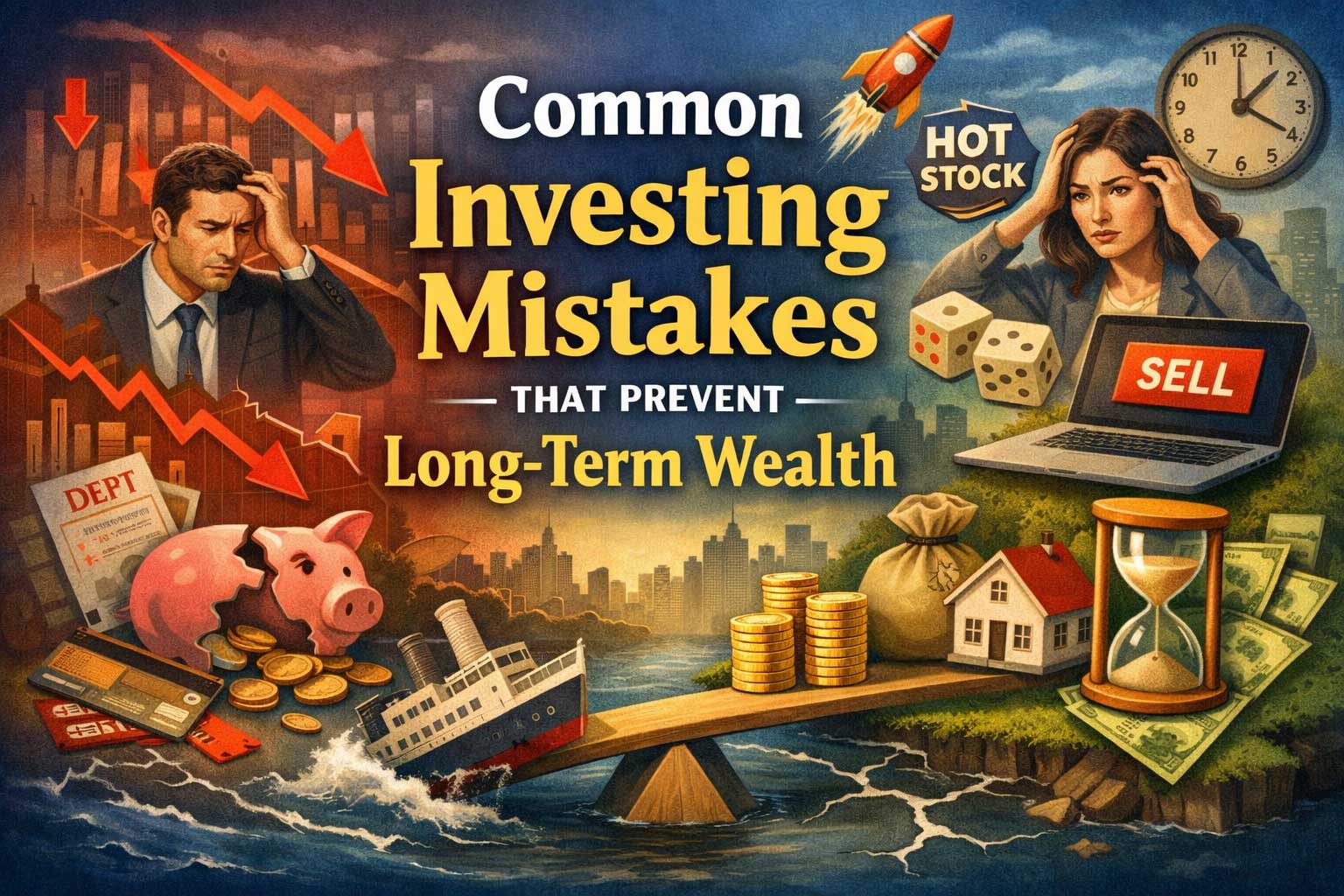
Long-term wealth is rarely destroyed by one dramatic event. More often, it’s drained by small, repeated mistakes—tiny leaks in a financial boat that looks fine from the outside. People tend to assume building wealth is mostly about picking the “right” investment. In reality, long-term investing is less about prediction and more about process: consistent contributions, sensible risk, disciplined behavior, cost control, and patience across decades.
That’s why the most expensive investing mistakes often feel harmless in the moment. A few “just this once” decisions—chasing a hot trend, panic-selling during a downturn, skipping contributions, paying unnecessary fees—can compound negatively in the same way good habits compound positively.
This article breaks down the most common investing mistakes that prevent long-term wealth, why they happen, what they cost you, and exactly how to fix them. The goal isn’t perfection. The goal is building a system that protects you from yourself and keeps your money working for you through good markets, bad markets, boring markets, and everything in between.
Note: This is educational content, not individualized investment advice. The best approach for you depends on your goals, timeline, income stability, and risk tolerance.
Why “Small” Mistakes Become Huge Over Time
Compounding is powerful—but it doesn’t care whether your habits are good or bad.
- A 1–2% difference in annual fees can silently take a major portion of your lifetime returns.
- Missing the best recovery days after a market drop can dramatically lower long-term performance.
- Overreacting emotionally during volatility can lock in losses and turn temporary declines into permanent damage.
- Delaying investing by even a few years can cost more than you think because the largest compounding happens later, and you need time to get there.
Long-term investing is like steering a ship across an ocean. If your compass is off by just a few degrees, you don’t notice at first. But over thousands of miles, you can end up in the wrong continent.
Mistake #1: Investing Without Clear Goals and a Time Horizon
Why it prevents wealth
If you don’t know what your money is for, you can’t choose the right strategy. Investing for “someday” tends to create a portfolio that’s either too risky (causing panic selling) or too conservative (failing to outpace inflation).
What it looks like
- Buying assets randomly because “they’re going up.”
- Switching strategies every year.
- Not knowing when you’ll need the money.
- Holding risky investments for short-term needs.
The fix: Define 3 things
- Goal (retirement, house, education, freedom fund, etc.)
- Time horizon (under 3 years, 3–10 years, 10+ years)
- Risk capacity (how much volatility you can financially survive, not just emotionally tolerate)
A simple framework:
- Short-term (0–3 years): prioritize stability and liquidity.
- Medium-term (3–10 years): balanced approach.
- Long-term (10+ years): growth-focused, diversified, and resilient.
When your timeline matches your portfolio, you stop making desperate decisions.
Mistake #2: Not Building an Emergency Fund Before Investing Aggressively
Why it prevents wealth
Without a cash buffer, every unexpected expense becomes a forced sale. Forced selling is one of the most damaging events in investing—especially during downturns.
What it looks like
- Investing everything, then using credit cards for emergencies.
- Selling investments at a loss to pay for repairs, medical bills, or job loss.
- Feeling constant anxiety about market drops because you “might need the money.”
The fix: Separate “safety money” from “growth money”
A practical baseline:
- 3–6 months of essential expenses in an emergency fund (more if income is unstable, you’re self-employed, or you support others).
This isn’t about missing investment returns; it’s about preventing catastrophic timing. Your emergency fund protects your long-term investments from short-term life.
Mistake #3: Trying to Time the Market (Buying and Selling Based on Predictions)
Why it prevents wealth
Market timing requires you to be right twice: when to get out and when to get back in. Most people miss the recovery, which often happens quickly and unpredictably.
What it looks like
- Selling “until things feel safer.”
- Waiting for the “perfect dip.”
- Switching to cash after scary headlines.
- Buying only after prices have already risen.
The hidden cost
If you miss a small number of strong rebound days over a decade, your returns can collapse. The market’s best days often cluster near its worst days—meaning panic-sellers frequently miss the bounce.
The fix: Use time, not timing
- Dollar-cost averaging: invest regularly, regardless of headlines.
- Rules-based rebalancing: adjust allocations based on a plan, not fear.
- Long-term perspective: accept that volatility is the price of admission for growth.
Instead of trying to predict weather, build a ship that can handle storms.
Mistake #4: Chasing Hot Trends and “Sure Things”
Why it prevents wealth
By the time something is popular, its price often already reflects extreme optimism. Trend-chasing pushes you to buy high and sell low—exactly the opposite of what works.
What it looks like
- Buying what everyone is talking about right now.
- Joining late because you feel left behind.
- Putting too much into one sector, theme, or “next big thing.”
- Treating speculation as investing.
The fix: Demand a process before you buy anything
Before adding an investment, answer:
- What role does this play in my portfolio?
- How does it behave in recessions or rate changes?
- What would make me sell, and why?
- How does it affect diversification?
- What’s the downside?
If you can’t explain it simply, don’t size it heavily.
Mistake #5: Overconcentration (Too Much in One Stock, Sector, Country, or Asset Type)
Why it prevents wealth
Concentration can create big wins, but it also creates portfolio-ending losses. Long-term wealth is usually built by staying in the game—not swinging for the fences with money you can’t afford to lose.
What it looks like
- One stock becomes 40–70% of your portfolio.
- Your job and your investments depend on the same industry.
- Everything you own is tied to one economy or currency.
- Your entire portfolio moves up and down together.
The fix: Diversify across multiple dimensions
True diversification can include:
- Asset classes: stocks, bonds, cash equivalents
- Geography: domestic and international exposure
- Sectors: tech, healthcare, consumer, industrials, etc.
- Style: growth and value
- Company size: large, mid, small
Diversification doesn’t guarantee profit. It reduces the chance a single mistake destroys decades of progress.
Mistake #6: Confusing Volatility With Risk
Why it prevents wealth
Many investors treat “price going down” as proof that something is bad, rather than a normal feature of markets. This misunderstanding triggers panic selling and creates permanent losses.
Volatility vs. real risk
- Volatility: prices move up and down (normal).
- Real long-term risk: failing to reach goals, losing purchasing power to inflation, overpaying fees, taking unrecoverable losses, or abandoning the plan.
The fix: Reframe volatility as a job requirement
If you want long-term growth, short-term discomfort is part of the deal. You can reduce volatility by:
- Holding a balanced allocation (not 100% in one asset)
- Maintaining an emergency fund
- Investing money you won’t need soon
- Using a clear plan for rebalancing and contributions
The investor who survives volatility is often the investor who wins.
Mistake #7: Selling During Market Crashes (Panic Selling)
Why it prevents wealth
Market downturns are when your future returns are often being set up. Selling after a drop locks in losses and removes your ability to benefit from the rebound.
What it feels like
- Fear that “this time is different”
- Shame about losses
- Pressure to “do something”
- Catastrophic thinking: imagining total collapse
The fix: Prepare before the crash happens
Build a “crash plan” while calm:
- A written rule: “I do not sell core long-term holdings during broad market declines.”
- A rebalancing rule: “If stocks fall and my allocation drifts, I rebalance gradually.”
- A contribution rule: “My contributions continue automatically.”
Panic is temporary. Permanent mistakes are not.
Mistake #8: Buying Based on Emotions (Greed, Fear, FOMO, Pride)
Why it prevents wealth
Emotions push you to do the wrong thing at the wrong time:
- Greed pushes you to overbuy when prices are high.
- Fear pushes you to sell when prices are low.
- FOMO pushes you to abandon your strategy.
- Pride makes you hold losers too long to avoid admitting you were wrong.
The fix: Automate discipline
- Automatic monthly investing
- Automatic transfers to savings
- Automatic rebalancing (or calendar-based)
- A written investment policy statement (simple rules you follow)
Your portfolio should not depend on your mood.
Mistake #9: Ignoring Fees, Expenses, and Hidden Costs
Why it prevents wealth
Fees compound against you year after year. Even “small” costs become enormous over decades.
Common costs include:
- Fund expense ratios
- Advisory fees
- Account maintenance fees
- Trading fees and spreads
- High turnover inside funds
- Tax drag (avoidable in some cases)
The fix: Treat every fee like a guaranteed negative return
Ask:
- What is the total annual cost of my investments and accounts?
- Are there lower-cost alternatives that achieve similar diversification?
- Am I paying for features I don’t use?
In long-term investing, cost control is one of the only “free lunches.”
Mistake #10: Not Understanding What You Own
Why it prevents wealth
People buy investments without understanding how they generate returns, what drives their price, or what risks they carry. This causes poor decisions when conditions change.
Examples
- Buying something because it “always goes up”
- Owning complex products without understanding downside scenarios
- Confusing speculation with a long-term plan
The fix: Use the “Explain it to a beginner” test
If you can’t explain:
- what it is,
- how it makes money,
- what makes it go down,
- why it belongs in your portfolio,
then it shouldn’t be a major holding.
Complexity is not a substitute for quality.
Mistake #11: Having No Asset Allocation Strategy
Why it prevents wealth
Asset allocation—how you split between growth assets and stabilizers—often matters more than picking individual investments. Without allocation, your portfolio becomes an emotional rollercoaster.
What it looks like
- Random mix of investments
- Too much risk for your timeline
- Too little risk for long-term goals
- No plan for how the portfolio should behave
The fix: Choose an allocation aligned to your horizon and temperament
A healthy allocation:
- matches your time horizon,
- allows you to sleep at night,
- keeps you invested during downturns.
The “best” allocation is the one you can stick with for years.
Mistake #12: Failing to Rebalance (Letting Winners or Losers Take Over)
Why it prevents wealth
Over time, parts of your portfolio grow faster than others. If you don’t rebalance, you may end up taking much more risk than you intended—right before a decline.
What it looks like
- One asset grows and dominates the portfolio
- Your “balanced” portfolio becomes risk-heavy
- You’re unaware your risk level changed
The fix: Rebalance with a simple rule
Two common methods:
- Calendar-based: rebalance every 6–12 months.
- Threshold-based: rebalance when an allocation drifts by a set percentage.
Rebalancing is a disciplined way to “sell some high and buy some low” without guessing.
Mistake #13: Underestimating Inflation (And Being Too Conservative for Too Long)
Why it prevents wealth
Inflation quietly erodes purchasing power. A portfolio that avoids volatility but fails to grow can still lead to financial pain later.
What it looks like
- Keeping long-term money mostly in cash
- Avoiding all market risk for decades
- Measuring progress only in account balance, not purchasing power
The fix: Match safety level to the job of the money
- Short-term money: prioritize stability
- Long-term money: needs growth potential to stay ahead of inflation
Your future self doesn’t need “the same number.” They need the same buying power—or more.
Mistake #14: Taking Too Much Risk With Money You’ll Need Soon
Why it prevents wealth
If you invest short-term money in volatile assets, you can be forced to sell during a downturn. This turns market volatility into a real loss.
The fix: Build time “buckets”
A simple bucket concept:
- Now bucket: monthly bills + emergency fund
- Soon bucket: money needed in the next few years
- Later bucket: long-term wealth building
This prevents your long-term plan from being hijacked by short-term needs.
Mistake #15: Not Increasing Contributions Over Time
Why it prevents wealth
Many people invest a fixed amount for years and assume they’re doing great. But as income rises, contributions should often rise too. Otherwise, lifestyle creep eats your wealth.
The fix: Automate contribution increases
Practical approaches:
- Increase investment contributions when you get a raise.
- Use an annual “financial upgrade” month to raise savings rate.
- Set a target savings/investing percentage, not just a dollar amount.
Long-term wealth is built more by how much you invest and how long you invest, not by perfect predictions.
Mistake #16: Trying to “Get Rich Quick” Instead of “Get Rich for Sure”
Why it prevents wealth
A get-rich-quick mindset encourages:
- concentrated bets,
- leverage,
- constant trading,
- chasing hype,
- ignoring risk.
It often leads to blowups that wipe out years of progress.
The fix: Adopt the boring wealth mindset
Boring can be beautiful:
- consistent investing,
- diversified exposure,
- cost control,
- patience.
The path to sustainable wealth is rarely exciting. It’s repeatable.
Mistake #17: Overtrading and Constantly “Optimizing”
Why it prevents wealth
Frequent trading can increase:
- fees,
- taxes,
- mistakes,
- emotional decisions.
More activity does not equal better results. For many investors, doing less is doing better.
The fix: Limit decision points
Instead of daily checking:
- choose monthly or quarterly review dates,
- set rules for changes,
- focus on contributions and allocation.
If your plan is sound, it should not require constant intervention.
Mistake #18: Ignoring Taxes and Account Structure
Why it prevents wealth
Taxes are a real drag on returns. While tax strategies vary by country and account type, ignoring them entirely can reduce long-term outcomes.
What it looks like
- Frequent selling that triggers taxes
- Holding tax-inefficient assets in the wrong account
- No awareness of how withdrawals will work later
The fix: Use a “tax-aware” mindset
General principles:
- Prefer long holding periods for long-term goals.
- Reduce unnecessary turnover.
- Understand how different accounts treat contributions, growth, and withdrawals.
You don’t need to become a tax expert—just avoid tax-unforced errors.
Mistake #19: Using Leverage Without Fully Understanding Downside Risk
Why it prevents wealth
Leverage can magnify gains, but it also magnifies losses—and can force liquidation at the worst time. A leveraged mistake can permanently destroy capital.
What it looks like
- Borrowing to invest without a stable cash flow buffer
- Using margin and being surprised by margin calls
- Chasing higher returns with borrowed money
The fix: Protect your survival first
Long-term investing is not only about returns—it’s about staying invested long enough for compounding to work. Avoid strategies that can wipe you out in one bad stretch.
Mistake #20: Falling for Scams, “Guaranteed Returns,” and Bad Information
Why it prevents wealth
A single scam can erase years of saving and investing. Even when it’s not a scam, low-quality advice can lead to high fees, poor products, and unrealistic expectations.
Red flags
- Guaranteed high returns with “no risk”
- Pressure to act immediately
- Lack of transparency
- Complex explanations meant to confuse
- Claims that sound too good to be true
The fix: Use a skepticism checklist
Before committing money:
- Can I clearly explain how returns are generated?
- Are risks openly discussed?
- Are fees fully transparent?
- Would I still do this if nobody else knew?
The best investments don’t need hype.
Mistake #21: Comparing Your Portfolio to Other People’s Wins
Why it prevents wealth
Comparison pushes you to take risks that don’t match your life. You might copy someone who:
- has more money,
- has a different timeline,
- has a different risk capacity,
- got lucky.
The fix: Measure progress against your plan
Better metrics:
- your savings rate,
- your contribution consistency,
- your emergency fund strength,
- your diversification,
- your long-term goals.
Other people’s highlight reels are not a strategy.
Mistake #22: Not Having a Plan for Down Markets
Why it prevents wealth
Every investor will face downturns. Without a plan, you improvise under stress—and improvise badly.
The fix: Pre-commit to a downturn protocol
A simple protocol:
- Confirm emergency fund is intact.
- Do not sell core long-term holdings due to fear.
- Continue automatic contributions.
- Rebalance if your rules say so.
- Reduce news consumption if it triggers panic.
- Focus on what you control: spending, saving, contributions.
Down markets are where long-term discipline is born.
Mistake #23: Letting Lifestyle Creep Replace Investing
Why it prevents wealth
As income grows, spending often grows faster. This reduces investing power and delays financial freedom.
The fix: Make investing the “first lifestyle upgrade”
Instead of upgrading everything at once:
- upgrade your investing percentage first,
- then upgrade lifestyle slowly.
A wealthy future is built by controlling the gap between what you earn and what you spend.
Mistake #24: Ignoring Behavioral Biases That Sabotage Decisions
Investors are human. Humans are not purely rational. Knowing common biases helps you design systems to avoid them.
Common biases
- Recency bias: assuming recent performance will continue forever
- Loss aversion: feeling losses more intensely than gains
- Confirmation bias: seeking information that supports your belief
- Anchoring: fixating on a past price
- Herd behavior: copying the crowd
The fix: Build guardrails
- Write rules when calm.
- Automate contributions.
- Diversify broadly.
- Limit portfolio checking.
- Review decisions on a schedule, not emotionally.
The goal is not to eliminate emotion—it’s to prevent emotion from driving the car.
Mistake #25: Ignoring Retirement Reality and Sequence Risk
Why it prevents wealth
Many investors focus only on average returns. But the order of returns matters, especially near retirement or when withdrawing funds. A bad sequence early in withdrawals can be damaging.
The fix: Gradually shift from “accumulation” to “resilience”
As you approach your spending years:
- ensure you have a plan for withdrawals,
- hold enough stability for near-term spending,
- reduce the chance you must sell growth assets during a downturn.
This isn’t about fear. It’s about structure.
Mistake #26: Not Tracking Progress (Or Tracking the Wrong Things)
Why it prevents wealth
If you don’t track, you don’t adjust. But if you track obsessively, you overreact.
Track what matters
- Savings rate (% of income invested)
- Total contributions per year
- Asset allocation drift
- Fees and costs
- Progress toward goals
Avoid tracking what triggers emotional decisions
- Daily price changes
- Short-term performance compared to friends
- Headlines that don’t affect your long-term plan
Measure process, not noise.
Mistake #27: Waiting to “Learn More” Before Starting
Why it prevents wealth
Perfectionism creates procrastination. Many people delay investing because they want certainty. But certainty doesn’t exist in markets—and time is your most valuable asset.
The fix: Start simple, then improve
A strong approach:
- begin with a diversified, low-complexity strategy,
- contribute consistently,
- learn gradually,
- refine over time.
Starting earlier with a simple plan often beats starting later with a perfect plan.
Mistake #28: Treating Investing Like Entertainment
Why it prevents wealth
If investing becomes entertainment, you’ll chase stimulation: constant trades, bold predictions, and adrenaline. But long-term wealth is built on boredom and repetition.
The fix: Separate “serious money” from “play money”
If you enjoy markets:
- keep long-term investments boring and rules-based,
- if you must speculate, keep it small and controlled,
- never let entertainment money threaten life goals.
The market is not a casino, but your brain might treat it like one if you let it.
The Long-Term Wealth “Anti-Mistake” Checklist
If you want a simple way to protect yourself from most investing mistakes, use this checklist as a recurring review (monthly or quarterly).
Foundations
- I have an emergency fund for unexpected expenses.
- My high-interest debt is controlled or being aggressively reduced.
- I invest money I won’t need soon.
Strategy
- I know my primary goals and timelines.
- My portfolio has a clear asset allocation.
- I am diversified (not overexposed to one area).
- I rebalance using a rule, not emotion.
Behavior
- I invest automatically on a schedule.
- I don’t change strategy based on headlines.
- I avoid trend-chasing and “sure things.”
- I limit portfolio checking to avoid overreaction.
Costs and efficiency
- I understand all fees I’m paying.
- My investing approach minimizes unnecessary turnover.
- I avoid complex products I can’t explain simply.
Growth
- I increase contributions as income rises.
- I track progress using process metrics (savings rate, contributions).
If you can consistently check most of these boxes, you’re already ahead of the majority of investors.
Putting It All Together: A Simple System That Builds Wealth
Long-term investing success is not about being the smartest person in the room. It’s about building a system that works even when you’re not feeling smart—especially when fear, excitement, or uncertainty is high.
A simple long-term system often looks like this:
- Stabilize your base: emergency fund, debt plan, budget control
- Set goals and timelines: know what the money is for
- Choose a diversified allocation: risk appropriate for your horizon
- Automate contributions: consistency beats intensity
- Control costs: reduce fees, reduce unnecessary trading
- Rebalance periodically: keep risk aligned with your plan
- Stay patient: let compounding do the heavy lifting
This approach is not flashy. It doesn’t make great social media content. But over 10, 20, 30 years, it tends to produce what most people actually want: stability, freedom, and sustainable wealth.
Final Takeaway: Wealth Is Built More by Avoiding Big Mistakes Than Making Perfect Picks
If you remember only one thing, remember this:
Long-term investing is less about finding the next winner and more about avoiding behaviors that force you out of the market or drain returns.
Avoid panic selling. Avoid trend-chasing. Avoid overconcentration. Avoid high fees. Avoid procrastination. Avoid making decisions without a plan.
Then do the simple things—consistently—for a long time.
That’s how long-term wealth is built.