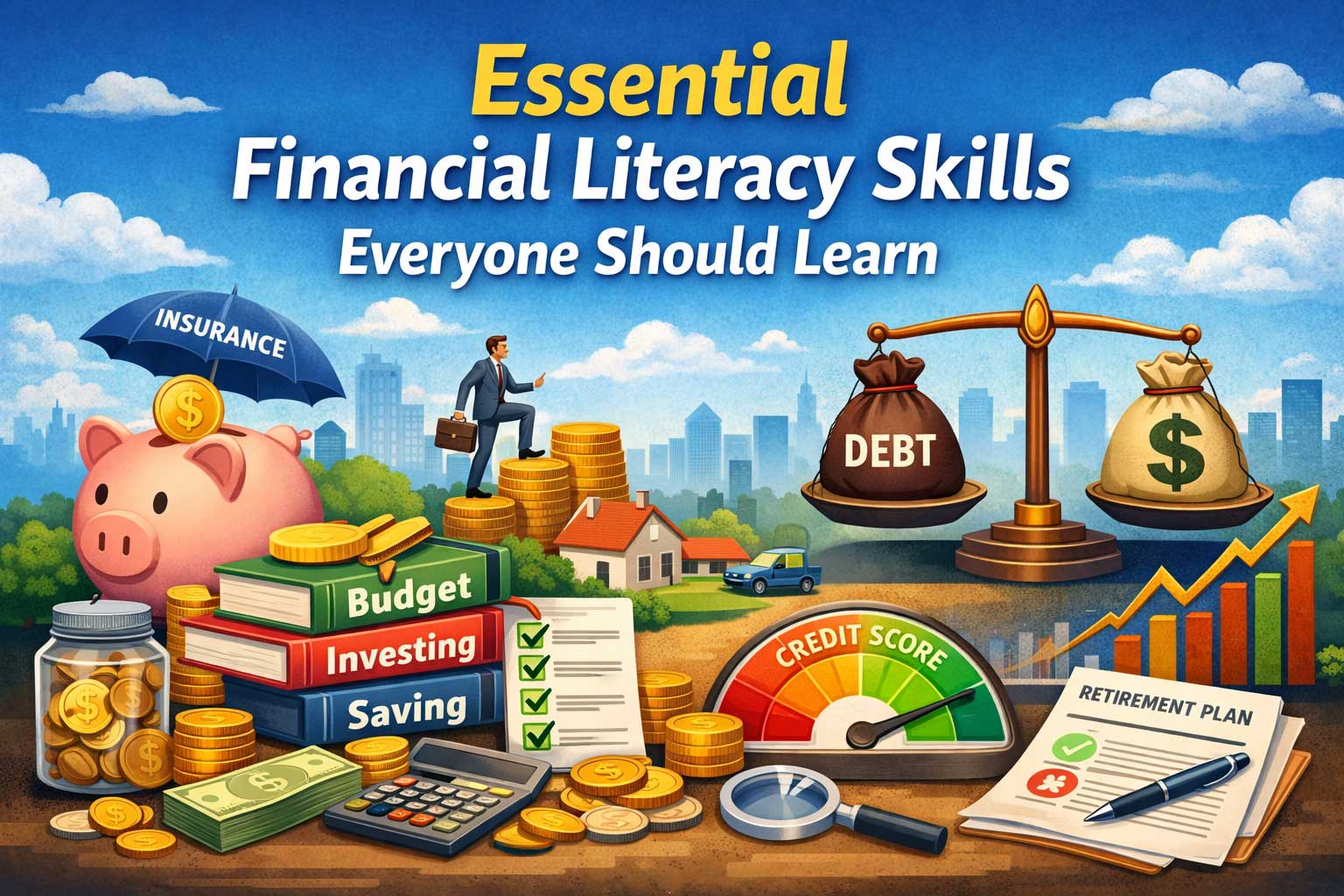
Financial literacy isn’t about being “good at math” or memorizing complicated terms. It’s about learning a set of real-life skills that help you make better decisions with money—decisions that affect your stress level, your options, your family, and your future. In today’s economy, you’re expected to navigate rising living costs, online payments, credit scores, subscriptions, buy-now-pay-later offers, investing apps, and constant marketing pressure. Meanwhile, many people were never taught how to budget, how interest works, how to compare loans, or how to invest. The result is predictable: more anxiety, more debt, and fewer choices. The good news is that financial literacy is learnable. You don’t need to be wealthy to start. You don’t need to be perfect. You just need the right skills, practiced consistently. This guide covers the essential financial literacy skills every person should learn—whether you’re a student, working adult, entrepreneur, parent, or someone rebuilding from past mistakes. Each section includes practical explanations, examples, and steps you can apply immediately.
What Financial Literacy Really Means
Financial literacy is the ability to:-
- Understand basic money concepts (income, expenses, interest, inflation, risk)
-
- Use financial tools wisely (bank accounts, credit cards, loans, insurance, investments)
-
- Make informed decisions (spending, saving, borrowing, investing, protecting yourself)
-
- Plan for the future (goals, emergencies, retirement, major purchases)
-
- Avoid common traps (predatory debt, scams, overspending, lifestyle inflation)
Skill 1: Understanding Cash Flow (The Foundation of Everything)
Cash flow is the movement of money in and out of your life.-
- Income: salary, wages, freelance work, business profit, dividends, side gigs, rental income
-
- Expenses: housing, food, transport, debt payments, subscriptions, entertainment, insurance, taxes
-
- Net cash flow: income minus expenses
Why cash flow matters more than salary
Two people can earn the same amount and have completely different financial lives:-
- Person A earns 2,000/month, spends 1,700/month → saves 300/month
-
- Person B earns 2,000/month, spends 2,100/month → debt grows 100/month
Practical habit: Track money for 14 days
You don’t need to track forever, but tracking for 14 days reveals patterns fast. Write down:-
- Every purchase
-
- Every bill
-
- Every subscription
-
- Every cash withdrawal
-
- Every delivery fee and “small” expense
-
- What was essential?
-
- What was convenience?
-
- What was emotional spending?
-
- What was forgettable?
Skill 2: Budgeting That Works in Real Life (Not on Paper)
A budget isn’t a punishment. It’s a plan that tells your money where to go before it disappears. A useful budget must be:-
- Simple enough to maintain
-
- Flexible enough to survive real life
-
- Clear enough to guide decisions
The 3 types of budgets (choose one you’ll actually use)
1) The Percentage Budget (simple and flexible)
A popular structure:-
- Needs: 50–60%
-
- Wants: 20–30%
-
- Saving/debt payoff: 10–30%
2) The Zero-Based Budget (great for control)
You assign every dollar a job:-
- Bills
-
- Food
-
- Transportation
-
- Savings
-
- Debt payoff
-
- Personal spending
3) The “Bills First” Budget (best for beginners)
You focus on:-
- Pay essential bills
-
- Pay minimum debts
-
- Save a small amount
-
- Spend what remains
The most important budgeting rule: separate fixed vs variable costs
-
- Fixed: rent, loan payments, insurance
-
- Variable: food, transport, entertainment, shopping
-
- Reducing fixed costs (housing, car, debt interest)
-
- Automating saving
-
- Putting guardrails on variable spending
Skill 3: Building an Emergency Fund (Your Financial Airbag)
An emergency fund protects you from turning every surprise into debt. Emergencies are not rare. They’re predictable:-
- Medical costs
-
- Job loss
-
- Family emergencies
-
- Car repairs
-
- Unexpected travel
-
- Business slowdowns
-
- Home repairs
How much should you save?
A realistic progression:-
- Starter buffer: 300–1,000 This prevents many small emergencies from becoming credit card debt.
-
- Stability fund: 1 month of essential expenses
-
- Full emergency fund: 3–6 months of essential expenses (More if income is irregular or you support others.)
“Essential expenses” means:
-
- Housing
-
- Utilities
-
- Basic food
-
- Transport to work
-
- Minimum debt payments
-
- Basic medical/insurance costs
-
- Dining out
-
- Shopping
-
- Travel
-
- Non-essential subscriptions
How to build it faster (without feeling deprived)
-
- Start with a small automatic transfer the day you get paid (even 1–5%)
-
- Put windfalls into the fund first (refunds, bonuses, gifts)
-
- Sell unused items and send proceeds to emergency savings
-
- Temporarily cut one category (subscriptions or delivery) to build momentum
Skill 4: Understanding Interest (Because Interest Is Either Helping You or Hurting You)
Interest is the price of borrowing money—or the reward for saving and investing.Two kinds of interest:
-
- Simple interest: calculated on the original amount
-
- Compound interest: calculated on the original amount plus accumulated interest
Example: Compounding in saving
If you invest 200/month and average a long-term return, the growth over years can become dramatic because earlier contributions have more time to compound.Example: Compounding in credit card debt
If you carry a balance and only pay the minimum, interest keeps stacking and stretches repayment into years.The literacy takeaway
You don’t need advanced math. You need to understand these truths:-
- Time matters more than you think.
-
- High interest rates are dangerous.
-
- Small, consistent actions become big outcomes over time.
Skill 5: Mastering Bank Accounts and Payment Tools
Basic banking sounds simple—until fees, overdrafts, and poor account structure quietly drain you.Key account types everyone should understand
-
- Checking account: daily spending, bill payments
-
- Savings account: emergency fund and short-term goals
-
- High-yield savings (where available): same purpose, better interest rate
-
- Certificates/term deposits (where available): higher interest, locked period
Essential banking habits
-
- Keep a small buffer in checking to avoid overdrafts and failed payments
-
- Review transactions weekly for errors and subscriptions you forgot
-
- Use alerts for low balance, large transactions, and unusual spending
-
- Avoid unnecessary fees: maintenance fees, ATM fees, overdraft fees
A simple account structure that works
-
- Account 1: Bills
-
- Rent/mortgage, utilities, insurance, minimum debt payments
-
- Account 2: Spending
-
- Food, transport, personal spending
-
- Account 3: Savings
-
- Emergency fund + goals
Skill 6: Credit Scores and Credit Reports (How Trust Is Measured)
Credit is essentially a trust system. A credit score is a summary of how you’ve handled borrowed money. Even if you don’t love the idea, credit affects:-
- Loan approvals
-
- Interest rates
-
- Renting approvals (in some places)
-
- Insurance pricing (in some places)
-
- Business financing options
The most important credit behaviors
-
- Pay on time, every time
-
- Keep credit utilization reasonable (don’t max out limits)
-
- Avoid applying for too many new accounts quickly
-
- Keep older accounts in good standing (history helps)
-
- Check reports for errors
Credit card literacy: use it like a tool, not a loan
A healthy approach:-
- Treat the credit card like a debit card (only spend what you already have)
-
- Pay the full statement balance each month
-
- Avoid “minimum payment mindset”
The biggest mistake people make
They confuse:-
- “I can afford the monthly payment” with
-
- “I can afford the purchase”
Skill 7: Debt Management (How to Borrow Without Getting Trapped)
Debt itself isn’t automatically “bad.” The problem is expensive debt and uncontrolled borrowing.Understand the difference: productive vs destructive debt
Potentially productive debt (still risky, but can build future value):-
- Education that increases earning power (when costs are reasonable)
-
- A mortgage you can afford with stable terms
-
- A business investment with a real plan and manageable risk
-
- High-interest credit card balances
-
- Payday or short-term high-fee loans
-
- Buy-now-pay-later stacking across multiple purchases
-
- Auto loans with unaffordable terms and rapid depreciation
-
- Debt taken to maintain a lifestyle
Two proven debt payoff methods
1) Debt Snowball (best for motivation)
-
- Pay minimums on all debts
-
- Put extra money on the smallest balance first
-
- When it’s paid off, roll that payment into the next debt
2) Debt Avalanche (best mathematically)
-
- Pay minimums on all debts
-
- Put extra money on the highest interest rate first
-
- Roll payments forward as debts disappear
A practical example
You have three debts:-
- Credit card A: 500 at high interest
-
- Credit card B: 1,200 at medium interest
-
- Personal loan: 3,000 at lower interest
Debt literacy includes negotiation
People forget you can often negotiate:-
- Interest rate reductions
-
- Payment plans
-
- Hardship programs
-
- Fee waivers
-
- Settlement (with consequences)
Skill 8: Knowing Your True Cost of Living (Lifestyle Inflation Awareness)
Lifestyle inflation happens when spending rises with income—so you feel stuck even after raises.The real danger
Many people increase:-
- Rent or housing upgrades
-
- Car payments
-
- Dining out
-
- Subscriptions
-
- Convenience purchases
A powerful habit: “Save first” raises
When income increases:-
- Automatically increase saving and investing first
-
- Upgrade lifestyle second
Skill 9: Goal Setting and Financial Planning (Turning Wishes Into Numbers)
Money goals become achievable when they’re specific and measurable. Instead of:-
- “I want to save more” Try:
-
- “I will save 3,000 in 12 months”
How to convert goals into monthly targets
Formula:-
- Goal amount ÷ months = monthly saving target
-
- Save 3,000 in 12 months → 250/month If that’s too high, extend the timeline or combine with income boosts and expense cuts.
The three layers of financial goals
-
- Short-term (0–12 months) Emergency fund, small debt payoff, basic savings
-
- Mid-term (1–5 years) Car replacement fund, house down payment, education, business setup
-
- Long-term (5+ years) Retirement, financial independence, generational goals
Skill 10: Investing Basics (Building Wealth Without Gambling)
Investing is one of the most misunderstood areas of personal finance. Many people either:-
- Avoid it completely (fear)
-
- Chase quick gains (risk)
Core investing concepts everyone should know
Risk and return
Generally:-
- Higher potential return comes with higher risk
-
- Lower risk tends to mean lower potential return
Diversification
Diversification means not relying on one investment, one company, or one sector. It reduces the damage of any single failure.Time horizon
-
- Money needed soon should not be heavily exposed to market swings
-
- Long-term money can usually tolerate volatility
Volatility is normal
Markets move up and down. The skill is not panicking during normal declines.Investing vs speculation
-
- Investing: buying assets with long-term value and strategy
-
- Speculation: betting on short-term price movements
A simple investing framework (conceptual)
-
- Build emergency fund first
-
- Pay off high-interest debt
-
- Invest regularly over time
-
- Use diversification
-
- Focus on long-term goals, not daily market noise
Skill 11: Retirement Planning (Even If Retirement Feels Far Away)
Retirement planning is really “future income planning.” It’s deciding how you will support yourself when you work less or stop working.Why starting early matters
Time gives compounding more power. Waiting often means you must contribute much more later to catch up.Retirement literacy basics
-
- Understand what retirement accounts/options exist in your country
-
- Know if employer matching exists (if applicable)
-
- Aim for consistent contributions, even small ones
-
- Increase contributions when income rises
-
- Avoid borrowing from retirement funds unless absolutely necessary
The mindset shift
Retirement isn’t an age. It’s a financial condition:-
- When your assets and income streams can cover your living expenses
Skill 12: Insurance Literacy (Protecting Your Progress)
Insurance is not an “investment.” It’s protection against financial disasters.Main types of insurance people should understand
-
- Health insurance (or health coverage systems)
-
- Life insurance (especially if others depend on your income)
-
- Disability coverage (income protection)
-
- Property/home/renter coverage
-
- Auto coverage
-
- Liability coverage
The literacy skill: insure the risks you can’t afford
Ask:-
- If this bad event happens, could I pay for it without destroying my finances?
Common mistakes
-
- Being over-insured on small risks but under-insured on major risks
-
- Buying policies without understanding exclusions and deductibles
-
- Skipping insurance while carrying high obligations (family, debt, business)
Skill 13: Basic Tax Literacy (So You Don’t Get Surprised)
Taxes can be complex, but basic literacy prevents costly mistakes.Tax literacy includes knowing:
-
- Your taxable income sources (salary, freelance, business, investments)
-
- Withholding vs actual tax liability
-
- Common deductions/allowances (country-specific)
-
- Deadlines and penalty risks
-
- How to keep records (especially for self-employed income)
Practical habit: keep a “tax folder”
Save:-
- Income proof documents
-
- Expense receipts (if relevant)
-
- Business costs (if applicable)
-
- Donation records (if applicable)
-
- Investment statements (if applicable)
Skill 14: Spending Psychology (The Hidden Side of Financial Literacy)
Money isn’t just math. It’s emotions, identity, and habits. Many people overspend because of:-
- Stress
-
- Social pressure
-
- Convenience addiction
-
- “I deserve it” thinking
-
- Scarcity mindset (“I might not get another chance”)
-
- Marketing tactics designed to trigger impulse
Three powerful strategies
1) The 24-hour rule
For non-essential purchases, wait 24 hours. Most impulse cravings fade.2) The “one in, one out” rule
If you buy a new item (clothing, gadgets), remove one. This reduces clutter spending.3) Identify your spending triggers
Track what you were feeling before purchases:-
- Tired?
-
- Angry?
-
- Celebrating?
-
- Bored?
Skill 15: Smart Consumer Skills (Comparing, Negotiating, and Reading the Fine Print)
This is a money skill most people underestimate.Learn to compare total cost, not just monthly cost
Monthly payments can hide:-
- Interest
-
- Fees
-
- Long terms that increase total cost
-
- Total paid over the full term
-
- Interest cost
-
- Penalties
-
- Flexibility
Negotiation is a financial skill
You can often negotiate:-
- Salary
-
- Phone/internet bills
-
- Medical bills (where relevant)
-
- Debt interest rates
-
- Service fees
-
- Rent renewal terms (sometimes)
-
- Car prices and add-ons
Subscription and contract literacy
Modern spending leaks through subscriptions:-
- Streaming
-
- Apps
-
- Software
-
- Memberships
-
- Storage
-
- Delivery services
-
- Review subscriptions monthly
-
- Cancel what you didn’t use in the last 30 days
-
- Replace multiple services with one (when possible)
Skill 16: Avoiding Scams and Financial Traps
Scams evolve fast, but the patterns stay the same.Common warning signs
-
- Guaranteed high returns with “no risk”
-
- Pressure to act immediately
-
- Secret methods or “insider” claims
-
- Requests for private codes or access
-
- Unclear fees
-
- Too-good-to-be-true discounts
-
- Emotional manipulation (fear, greed, urgency)
Practical safety habits
-
- Use strong, unique passwords and two-factor authentication
-
- Never share verification codes
-
- Double-check recipients before sending money
-
- Be careful with public Wi-Fi for banking
-
- Keep devices updated
Skill 17: Building Multiple Income Streams (Without Falling for Hype)
Income growth is a powerful lever, but it must be realistic.Types of income
-
- Active income: paid for time (job, freelance work)
-
- Leverage income: paid from systems (business operations, scalable services)
-
- Asset income: paid from ownership (investments, rentals, royalties)
Literacy means understanding trade-offs
-
- Side gigs can increase income but cost time and energy
-
- Businesses can scale but require risk, planning, and patience
-
- Investing grows wealth but needs consistency and time
Skill 18: Planning for Major Purchases (Car, Home, Education, Business)
Big decisions create long-term financial outcomes.Major purchase checklist
Before you buy:-
- Can you afford it without sacrificing emergency savings?
-
- What is the total cost (maintenance, insurance, taxes, repairs)?
-
- What is the opportunity cost (what else could this money do)?
-
- What happens if income drops temporarily?
-
- Can you delay the purchase and improve terms?
The “future you” test
Ask:-
- Will I be happy paying for this every month six months from now?
Skill 19: Money Communication (Relationships and Family)
Money problems often become relationship problems because they are not discussed clearly.Essential communication skills
-
- Talk about goals, not just spending rules
-
- Agree on priorities (security, travel, family support, investing)
-
- Set shared budgets and personal spending allowances
-
- Schedule monthly “money meetings”
-
- Avoid shame language; focus on solutions
Skill 20: Creating a Personal Money System (So You Don’t Rely on Willpower)
The most financially stable people don’t depend on motivation every day. They build systems.A simple money system anyone can use
-
- Automate essentials
-
- Bills auto-pay (when safe)
-
- Savings auto-transfer
-
- Use a weekly check-in
-
- Review balances
-
- Pay pending bills
-
- Check spending categories
-
- Adjust before it becomes a problem
-
- Create rules Examples:
-
- “I only eat out twice per week.”
-
- “I don’t buy non-essentials before payday.”
-
- “I save 10% of every payment.”
-
- Use sinking funds Sinking funds are mini-savings categories for predictable future expenses:
-
- Car maintenance
-
- Gifts
-
- Travel
-
- School fees
-
- Home repairs
-
- Annual insurance
A Practical Skill Map: What to Learn First (If You’re Overwhelmed)
If you’re starting from zero, follow this order:-
- Cash flow awareness (track spending)
-
- Basic budget (bills first)
-
- Starter emergency fund
-
- Pay off high-interest debt
-
- Build 1–3 months of expenses
-
- Learn credit basics and protect your score
-
- Begin investing regularly (long-term focus)
-
- Insurance and tax organization
-
- Long-term planning and wealth strategy
Real-Life Examples (How These Skills Look in Practice)
Example 1: The “Always Broke” Cycle
-
- Income: 1,800/month
-
- Fixed costs: 1,300 (rent, utilities, transport, minimum debts)
-
- Variable spending: 650
-
- Net: -150/month
-
- Track variable spending and cut 200/month (subscriptions, delivery, impulse shopping)
-
- Add 100/month income (small side work, overtime, selling items)
-
- Result: +150/month positive cash flow
-
- Build starter emergency fund: 150/month → 900 in 6 months
Example 2: Debt Payoff Turning Point
-
- Credit card balance: 2,000
-
- Paying only minimum: debt lasts years and costs large interest
-
- New plan:
-
- Cut 80/month in spending
-
- Add 70/month income
-
- Pay extra 150/month toward card
-
- Result: payoff timeline shrinks dramatically and stress decreases
Example 3: Investing Without Overthinking
-
- Person invests a small amount monthly
-
- Keeps emergency fund separate
-
- Avoids panic selling during downturns
-
- Increases contribution with each raise
Essential Checklists
Monthly Financial Health Checklist
-
- [ ] Bills paid or scheduled
-
- [ ] Savings transferred automatically
-
- [ ] Debt payments made
-
- [ ] Spending reviewed (what went off track?)
-
- [ ] Subscriptions reviewed (cancel unused)
-
- [ ] Emergency fund status checked
-
- [ ] One financial task completed (update budget, compare insurance, negotiate bill)
Credit Card Safety Checklist
-
- [ ] Pay full statement balance (or pay down aggressively)
-
- [ ] Keep utilization under control
-
- [ ] Avoid cash advances
-
- [ ] Don’t open new accounts impulsively
-
- [ ] Check for suspicious transactions
Debt Decision Checklist (Before borrowing)
-
- [ ] Is this a need or a want?
-
- [ ] Can I delay and save instead?
-
- [ ] What is the interest rate and total cost?
-
- [ ] What fees and penalties exist?
-
- [ ] Is the monthly payment affordable even if income drops?
-
- [ ] Do I have an emergency fund?
The 30–60–90 Day Financial Literacy Action Plan
First 30 Days: Stabilize
-
- Track every expense for 14 days
-
- Create a simple bills-first budget
-
- Cut one major spending leak (subscriptions, delivery, impulse shopping)
-
- Build a starter emergency buffer (even small)
-
- Pay minimums on all debts on time
Days 31–60: Build Momentum
-
- Create one sinking fund (car, medical, gifts, home repairs)
-
- Choose a debt payoff method (snowball or avalanche)
-
- Increase income slightly (sell items, small side gig, renegotiate something)
-
- Set up banking alerts and weekly money check-ins
Days 61–90: Upgrade Your Strategy
-
- Build emergency fund toward one month of essentials
-
- Improve credit habits (reduce balances, pay on time)
-
- Learn basic investing principles and start consistent contributions (if you’re ready and stable)
-
- Review insurance needs and basic tax organization
-
- Create a 1-year financial goal with a monthly target
Common Myths That Keep People Stuck
Myth 1: “I don’t earn enough to manage money.”
If money is tight, literacy matters even more. Small changes create breathing room. You don’t need a high income to build good systems.Myth 2: “Budgeting means no fun.”
Budgeting means you decide what matters. Fun is allowed—just planned.Myth 3: “Investing is only for rich people.”
Investing is for consistent people. Small amounts matter, especially with time.Myth 4: “Debt is normal, everyone has it.”
Debt may be common, but high-interest debt is not harmless. Normal isn’t the same as healthy.Myth 5: “I’ll start when life is calmer.”
Life rarely gets calmer on its own. A simple system creates calm.Frequently Asked Questions
How do I start if I feel overwhelmed?
Start with the smallest, highest-impact steps: track spending for 14 days, make a simple budget, and build a starter emergency fund. Then focus on paying down high-interest debt.What if I make mistakes?
Mistakes are part of the process. Financial literacy is not about never slipping—it’s about noticing faster, correcting faster, and improving over time.Should I save or pay debt first?
In many situations, build a small emergency buffer first (to prevent new debt), then prioritize high-interest debt. After that, build your emergency fund larger and invest for long-term goals.How long does it take to become financially literate?
You can learn the basics in weeks, build strong habits in months, and create real long-term results over years. The key is consistent practice.What is the single most important skill?
Cash flow management. If you can consistently spend less than you earn and direct the difference toward savings, debt payoff, and investing, everything else becomes easier.Conclusion: Financial Literacy Is Freedom in Disguise
Essential financial literacy skills are not about becoming obsessed with money. They’re about reducing stress, increasing options, and protecting your future. When you understand cash flow, budgeting, saving, credit, debt, investing, insurance, and planning, you stop feeling confused and start feeling capable. You make decisions with intention instead of pressure. You recover faster from setbacks. You build stability even in uncertain times. If you do nothing else, commit to this:-
- Track your spending
-
- Build a simple budget
-
- Save a starter emergency fund
-
- Pay down high-interest debt
-
- Learn investing basics and start small when you’re ready